
This is a paid edition of The Next 1000 Days. If someone forwarded this to you, you can subscribe below.
Last week, I introduced Richard Koch’s Star Business framework — the idea that the only private business worth acquiring at a premium is one with both a dominant position and a growing market. Stars are rare. They compound. Their owners rarely let go.
I ended that piece with a tease: what about everything else?
This is that piece.
The 2×2 You Need Tattooed Somewhere Visible
Koch’s framework is a direct descendant of the Boston Consulting Group matrix — the one MBA students have been drawing on whiteboards since the 1970s. But it’s worth restating it plainly, because the categories are doing real work here.
Market growth is the vertical axis. Is the total market for this product or service expanding, contracting, or flat?
Relative market share is the horizontal axis. Does this business lead its local market, or is it one of several?
Plot any business on those two axes and you get four quadrants:
Star — growing market, leading position. Buy at almost any reasonable price; the business will grow into its valuation.
Cash Cow — flat or slow market, leading position. Buy at the right price; it will pay you steadily for years.
Question Mark — growing market, weak position. Buy only if you have a clear, credible plan to build share.
Dog — flat or declining market, weak position. Walk away. The seller knows something you don’t, or they’ve already given up caring.
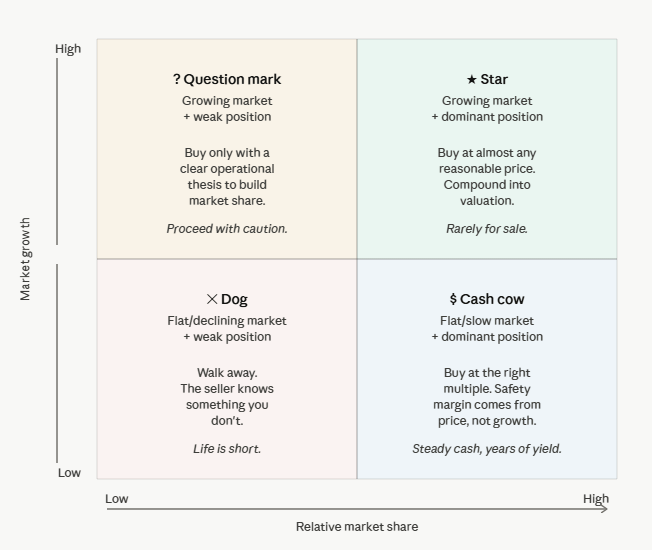
Most serious investors treat this as a binary: Stars only. I think that’s too rigid. A well-priced Cash Cow, bought with clear eyes, is an excellent investment. It won’t make you rich on multiple expansion. But it will generate real, relatively predictable cash; and in a world of 7% mortgage rates and expensive equity, predictable cash is underrated.
The error is paying Star prices for Cash Cow businesses. That’s the broker’s job, and they’re usually good at it.
Why Stars Rarely Appear on Broker Listings
Let me be honest about what business brokers actually have.
A business owner who knows they have a Star — a business with genuine market leadership in a growing sector — has very little incentive to sell at a standard broker multiple. They’re sitting on a compounding machine. The rational move is to keep compounding, or to sell via a process specifically designed to surface the full strategic value: an investment banker, a trade buyer, or a private equity process.
What brokers predominantly have is Cash Cows, Question Marks, and Dogs with good photography.
That isn’t cynicism. It’s just how markets clear. The businesses that appear on LINK Business or Goodbusiness.co.nz are there because the owner wants or needs liquidity at a price that doesn’t require a full strategic sales process. That’s a legitimate reason to sell. But it tells you something about the asset.
When you scroll broker listings, your default assumption should be: this is probably a Cash Cow at best. The question is whether it’s a good Cash Cow, and whether the price reflects that.
The Cash Cow Case
Here’s the thing about Cash Cows that gets undersold: they are, in many ways, easier to evaluate than Stars.
With a Star, you’re partly underwriting a growth thesis. You’re making a bet that the market continues to expand, that the business holds its position, and that the multiple you pay today is justified by the earnings five years out. That’s hard. You can be right about the business and wrong about the timing.
With a Cash Cow, the question is simpler: how durable is the current cash flow, and what is that durability worth?
